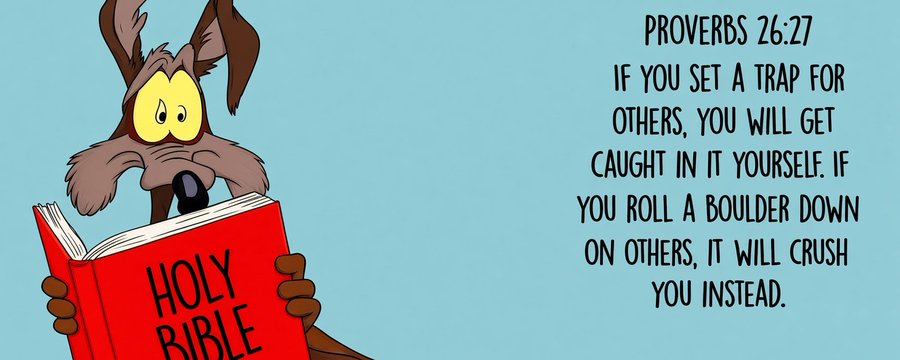
Wile E. Coyote had tried everything. ACME rocket skates. Catapults disguised as mailboxes. A boulder rigged with a tripwire and a helpful “FREE BIRD SEED” sign. Every single plan ended the same way: the Road Runner went “beep-beep,” and Coyote became the punchline, usually while flattened under his own clever idea.
One particularly bruised morning he sat on a cactus, staring at the latest hole in the ground that had been meant for someone else. In a fit of desperation—or maybe just because the package was cheaper than another anvil—he ordered a book. When it arrived it was red, thick, and surprisingly free of spring-loaded boxing gloves. The cover simply said HOLY BIBLE.
He opened it somewhere near the middle and read Proverbs 26:27:
“If you set a trap for others, you will get caught in it yourself. If you roll a boulder down on others, it will crush you instead.”
Coyote’s ears went up. His eyes got very wide. For the first time in decades, the universe seemed to be speaking his language.
The verse was not a suggestion. It was a weather report. Set a snare, and the snare develops a personal interest in you. Push a boulder, and gravity files a formal complaint with your name on it. Coyote had been living the illustrated edition of that proverb for years and never noticed he was the main character.
Most of us are not quite so cartoonish, yet the principle still holds. We smile and offer “helpful” information that is really a carefully aimed rock. We stay quiet when a half-truth would make someone else look worse and us look better. We rehearse the perfect comeback and call it justice. Then we are shocked when the same snare tightens around our own ankle, or when the story we started rolling comes back downhill at twice the speed.
Scripture does not say, “Don’t ever protect yourself,” or “Pretend the Road Runner is your best friend.” It simply observes that schemes aimed at other people’s downfall have a way of becoming self-addressed. God is not mocked by clever engineering, whether the device is an ACME product or a whispered rumor. What we plant, we harvest—sometimes with a large cartoon rock attached.
Coyote, for once, closed the book carefully instead of using it as a projectile. He still wanted the Road Runner. He just no longer trusted his own blueprints. That is often the first small step of wisdom: realizing that the person most likely to be caught in the trap we are building is the one holding the hammer.
And somewhere on the desert floor, a very small bird kept running, blissfully unaware that the coyote had finally read the warranty.
A Few Questions for the Rest of Us (Who Don’t Order from ACME)
- Where am I currently “improving” a situation by leaving out a key detail, steering a conversation, or quietly hoping someone else trips—so that I look better or stay safer?
- If my hidden motives were turned into a cartoon blueprint and played on a loop, would I still be proud of the design, or would I start looking for the exit?
- What would it look like this week to drop the boulder (or the subtle snare) and simply tell the truth, trust the outcome to God, and let the Road Runner run?

